Campfire Reunions
Lyrics for Singalongs and Original Songs
Click a picture or song title for the full lyrics.
Category: Willow Wind
Assisted Living
-

“Let Me Call You Sweetheart,” published in 1910, is a popular American love song written by Beth Slater Whitson (lyrics) and Leo Friedman (music). Originally a hit for tenor Arthur Clough and the Peerless Quartet in 1911, its simple, sentimental melody made it a lasting standard.
-

The song “My Wild Irish Rose,” written and composed by Chauncey Olcott, was inspired by an actual flower given to his wife Margaret by a young boy in Killeagh, County Cork, Ireland, in 1898.
-

This popular American song was written by Larry Shay, Mark Fisher, and Joe Goodwin in 1928. It became an enduring jazz standard, with its optimistic message. Despite being embraced during the Great Depression, the song was originally published in 1928, a time of prosperity before the Wall Street crash.
-

In 1908, Jack Norworth wrote this song on some scrap paper on a train ride to Manhattan, New York. He gave those paper scrap lyrics to Albert Von Tilzer who composed the music which in turn was published by the York Music Company and before the year was over, a hit song was born.
-

This popular song originated from the melody of the “Levee Song,” which was first published in Princeton University’s 1894 songbook, Carmina Princetonia. The original lyrics were about African American laborers building levees, but as the focus of Black labor shifted to railroad construction, the lyrics were adapted to reflect this new context.
-

“Oh! Susanna,” written in 1847 and published in 1848, made Stephen Foster an instant success as a composer and launched his musical career.
-

This hit 1958 song by the Everly Brothers achieved massive success, topping multiple Billboard charts including a #1 hit in the UK at the time. It was recognized by the Rock and Roll Hall of Fame as one of the “500 Songs that Shaped Rock and Roll”.
-

Originally a 19th-century poem by Dr. Brewster M. Higley of Kansas, “Home on the Range” was set to music by Daniel E. Kelley. Beloved for its imagery of the American West, it became the official state song of Kansas in 1947 and is often called the “cowboy’s anthem.”
-

Written by Les Brown, Ben Homer, and Bud Green in 1944, “Sentimental Journey” became Doris Day’s first big hit with Les Brown’s band in 1945. Released as WWII ended, it resonated with soldiers returning home. Trivia: it’s often called the unofficial anthem of homecomings and launched Day’s legendary career.
-

Written by Redd Stewart and Pee Wee King in 1946, “Tennessee Waltz” became a massive hit when Patti Page recorded it in 1950. Blending country and pop, it tells of love lost to a friend—and became one of Tennessee’s official state songs and one of the best-selling singles of its era.
-

Written by Wayland Holyfield and Bob House, “Could I Have This Dance” was released by Anne Murray in 1980 for Urban Cowboy. It became a country-pop crossover hit, won a Grammy, and is now a wedding favorite—treasured for its gentle melody and heartfelt promise of lasting love.
-

Katharine Lee Bates wrote the poem in 1893 after visiting Pikes Peak; it was later set to Samuel A. Ward’s 1882 melody. First published in 1895, it gradually gained popularity and was often proposed as a national anthem alternative for its sweeping imagery and inclusive vision of America.
-

Written by Irving Berlin in 1918 and revised in 1938, this patriotic anthem gained fame through Kate Smith’s heartfelt radio debut. Especially beloved during wartime and national crises, it’s often called America’s “second national anthem” for its unifying and prayerful tone.
-

“You Are My Sunshine” was first recorded in 1939 and is often credited to Jimmie Davis and Charles Mitchell. Davis, a country singer and future Louisiana governor, popularized the song, which went on to become one of the most recorded and enduring American folk tunes of the 20th century.
-

“This Land Is Your Land” was written by Woody Guthrie in 1940 as a response to “God Bless America.” It became a powerful anthem of inclusion and protest, widely embraced in folk and social justice movements.
-
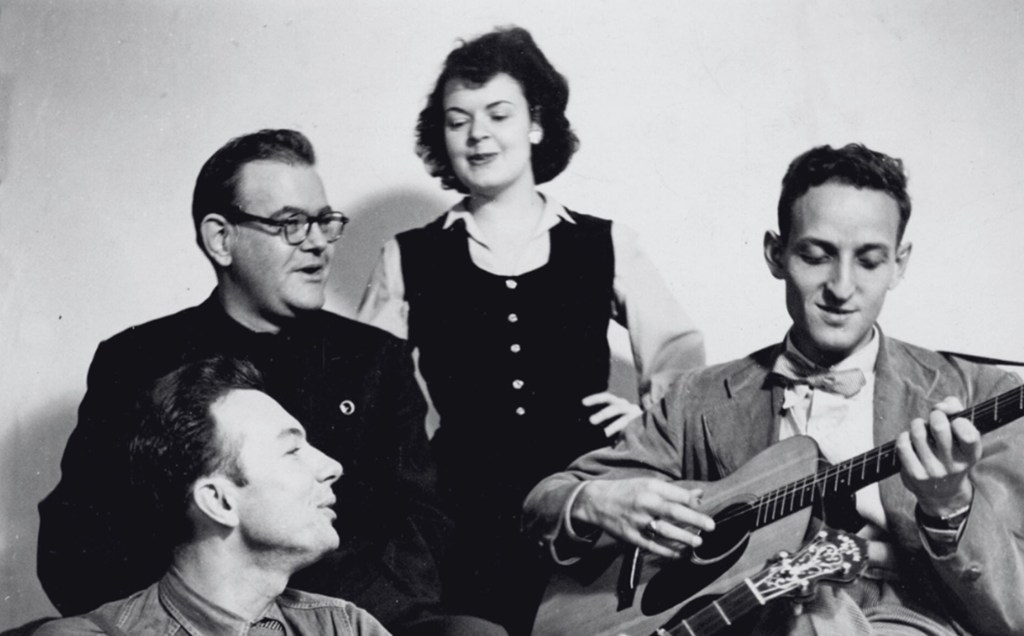
“Goodnight Irene” was originally written by Lead Belly (Huddie Ledbetter) in the 1930s and popularized after his death by The Weavers in 1950. Its haunting melody and bittersweet lyrics helped bring American folk music into the mainstream.
-

“L-O-V-E” was written by Bert Kaempfert and Milt Gabler in 1964 and made famous by Nat King Cole. Originally recorded as an instrumental, the song gained popularity with Cole’s charming vocal version, becoming a timeless standard of jazz-influenced pop.
-

“Jamaica Farewell” is a traditional Jamaican mento song, popularized by Harry Belafonte in 1956. Though often attributed to Lord Burgess (Irving Burgie), it draws from older folk roots. Belafonte’s recording helped introduce Caribbean music to international audiences.
 Campfire Reunions