
These lyrics are in the public domain.
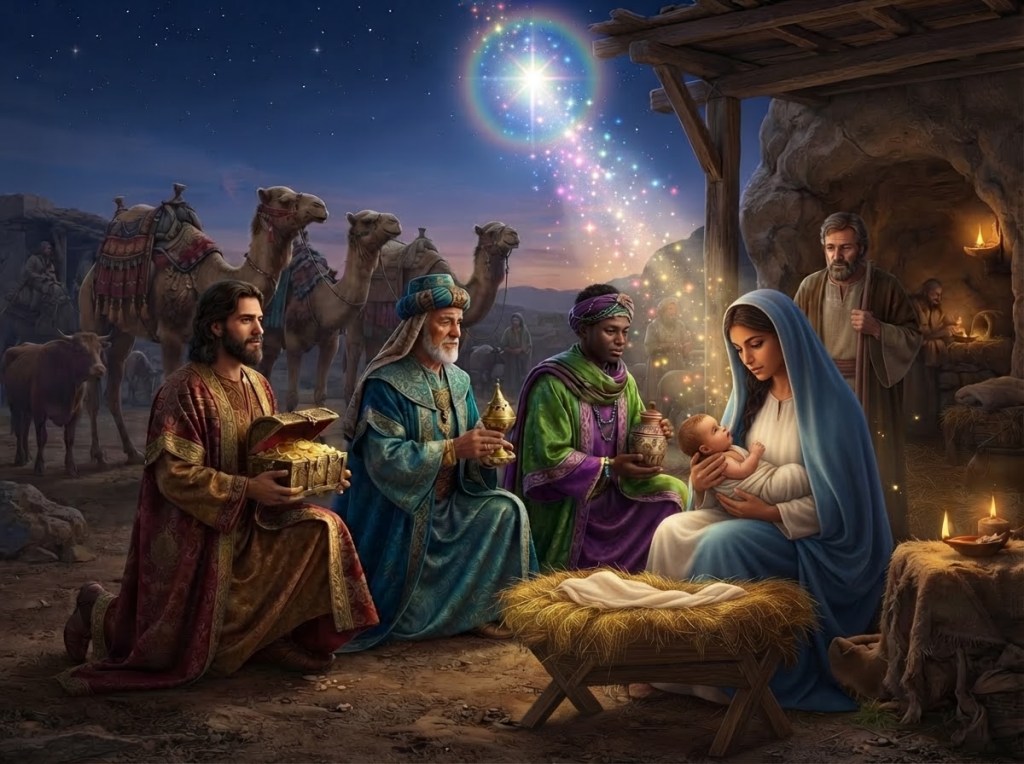
We three kings of Orient are
Bearing gifts we traverse afar
Field and fountain, moor and mountain
Following yonder star
O star of wonder, star of night
Star with royal beauty bright
Westward leading, still proceeding
Guide us to thy perfect light
Born a King on Bethlehem’s plain
Gold I bring to crown Him again
King forever, ceasing never
Over us all to reign
O star of wonder, star of night
Star with royal beauty bright
Westward leading, still proceeding
Guide us to thy perfect light
Frankincense to offer have I
Incense owns a Deity nigh
Prayer and praising, all men raising
Worship Him, God on high
O star of wonder, star of night
Star with royal beauty bright
Westward leading, still proceeding
Guide us to thy perfect light
Myrrh is mine, its bitter perfume
Breathes a life of gathering gloom
Sorrowing, sighing, bleeding, dying
Sealed in the stone-cold tomb
O star of wonder, star of night
Star with royal beauty bright
Westward leading, still proceeding
Guide us to thy perfect light
Glorious now behold Him arise
King and God and Sacrifice
Alleluia, Alleluia
Sounds through the earth and skies
O star of wonder, star of night
Star with royal beauty bright
Westward leading, still proceeding
Guide us to thy perfect light
We Three Kings
Written by John Henry Hopkins Jr., 1857
Most of the carols we sing at Christmastime came to us from England or Europe. “We Three Kings” grew up right here in America. Its writer, John Henry Hopkins Jr., was born in Pittsburgh in 1820, the son of a well-known Episcopal clergyman. He worked as a newspaper reporter in New York for a while before entering the General Theological Seminary in Manhattan, and after he was ordained he became the seminary’s first music teacher. He also founded and edited a church newspaper called the Church Journal. Hopkins wrote both the words and the tune of this carol himself.
You may have heard that he wrote it for a Christmas pageant at the seminary in 1857, or as a holiday gift for his young nieces and nephews. Those stories are lovely, but hymn historians who went through his newspaper, the seminary’s records, and his biographies couldn’t find either one mentioned. The earliest trace of the carol is a notice in the Church Journal in December 1858, announcing a new carol called “The Three Kings of Orient.” That same month, it was listed as a “new” song at a school’s end-of-term program in New York. Hopkins later gathered it into his own songbook, Carols, Hymns, and Songs, in 1863.
Hopkins wrote the carol as a little drama for three men. All three sang the first and last verses together. In between, each king stepped forward to sing a solo about his gift: Gaspard with gold, Melchior with frankincense, and Balthasar with myrrh. Everyone joined in on the bright chorus about the star. The verses are in a minor key, which gives them that ancient, traveling feel, and the myrrh verse turns quite somber, looking ahead to sorrow before the joyful last verse. Hopkins wrote the music so children could sing it easily, and they took to it right away. It became a favorite in Sunday school songbooks, and it’s a big part of why so many Christmas pageants still have three youngsters in paper crowns walking slowly up the aisle.
Interestingly, the Gospel story never actually says there were three visitors, or that they were kings. It speaks of wise men from the East who brought three gifts, and over the centuries people decided there must have been one traveler per gift. Hopkins meant his song for Epiphany, the January 6 feast that remembers the wise men’s arrival, though most of us sing it all through the season.
The carol made it across the Atlantic too. Two English editors, Henry Ramsden Bramley and John Stainer, put it in their well-known collection Christmas Carols New and Old, the only American piece in that set. It caught on in England so completely that some printers began labeling it “Old English,” as if it had been sung there for centuries. It’s often called the first American Christmas carol to become widely popular.
As a carol, “We Three Kings” never appeared on the record charts, but it has been sung and recorded so many times, by church choirs and by pop, jazz, and rock artists alike, that it hardly needed to.


Leave a Reply