
These lyrics are in the public domain.
Dashing through the snow
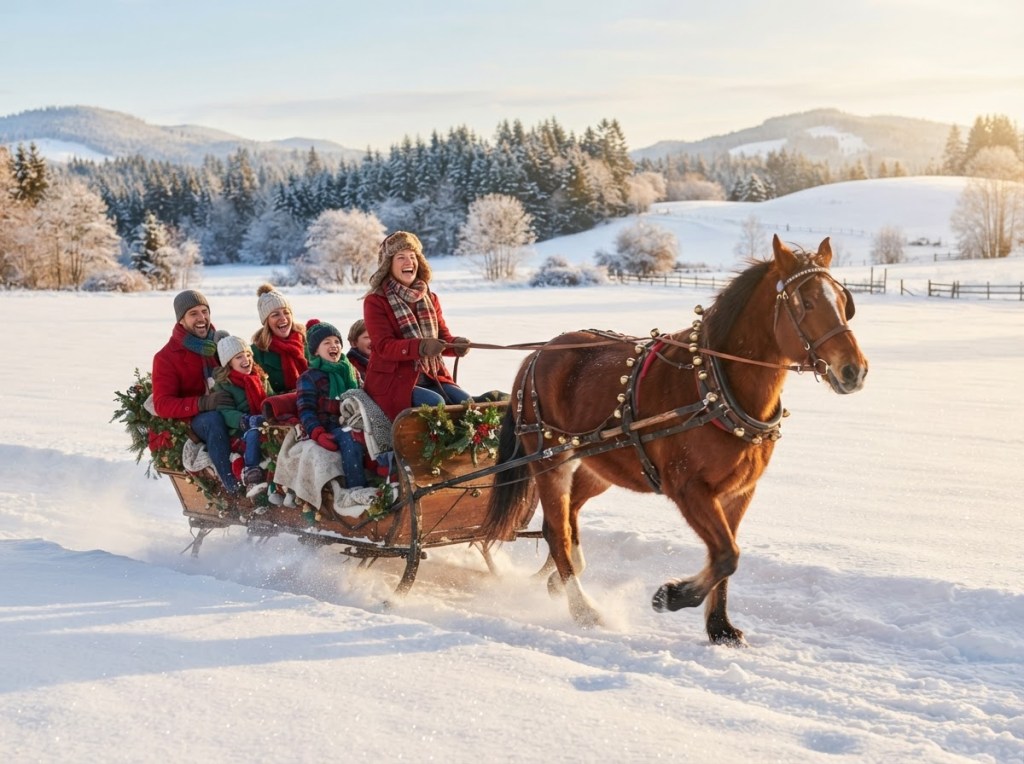
In a one-horse open sleigh
O’er the fields we go
Laughing all the way
Bells on bobtail ring
Making spirits bright
What fun it is to ride and sing
A sleighing song tonight
Jingle bells, jingle bells
Jingle all the way
Oh what fun it is to ride
In a one-horse open sleigh, hey
Jingle bells, jingle bells
Jingle all the way
Oh what fun it is to ride
In a one-horse open sleigh
A day or two ago
I thought I’d take a ride
And soon Miss Fanny Bright
Was seated by my side
The horse was lean and lank
Misfortune seemed his lot
He got into a drifted bank
And then we got upsot
Jingle bells, jingle bells
Jingle all the way
Oh what fun it is to ride
In a one-horse open sleigh, hey
Jingle bells, jingle bells
Jingle all the way
Oh what fun it is to ride
In a one-horse open sleigh
A day or two ago
The story I must tell
I went out on the snow
And on my back I fell
A gent was riding by
In a one-horse open sleigh
He laughed as there I sprawling lie
But quickly drove away
Jingle bells, jingle bells
Jingle all the way
Oh what fun it is to ride
In a one-horse open sleigh, hey
Jingle bells, jingle bells
Jingle all the way
Oh what fun it is to ride
In a one-horse open sleigh
Now the ground is white
Go it while you’re young
Take the girls tonight
And sing this sleighing song
Just get a bobtailed bay
Two forty as his speed
Hitch him to an open sleigh
And crack! You’ll take the lead
Jingle bells, jingle bells
Jingle all the way
Oh what fun it is to ride
In a one-horse open sleigh, hey
Jingle bells, jingle bells
Jingle all the way
Oh what fun it is to ride
In a one-horse open sleigh
Jingle Bells
Written by James Lord Pierpont, 1857
It may be the best-known winter song in the world, but “Jingle Bells” started life under a different name. James Lord Pierpont first published it in Boston on September 16, 1857, as “The One Horse Open Sleigh.” Two years later it came out again with a new title, “Jingle Bells, or The One Horse Open Sleigh,” and the catchier name stuck.
Here’s something to point out at your next singalong: the song never mentions Christmas at all. It’s about the fun of a winter sleigh ride, and it only became tied to the holidays in the 1860s and 1870s. If you keep singing past the first verse, the story turns playful. Our narrator takes a ride with Miss Fanny Bright, his skinny horse runs them into a snowdrift, and they end up “upsot,” an old joking way of saying upset. In the next verse he falls flat on his back in the snow while a passing gentleman laughs and drives off.
Two towns still argue over where the song was born. A plaque in Medford, Massachusetts, says Pierpont wrote it there in 1850, inspired by the sleigh races on Salem Street. Savannah, Georgia, has its own marker, because Pierpont was the organist at the Unitarian church there when the song was published. You may also have heard that it was written for a Thanksgiving Sunday school program. It’s a charming story, but historians have found no evidence for it.
The real beginning is less sweet. Kyna Hamill, a theater historian at Boston University, found a playbill showing that the song’s first known performance was on September 15, 1857, at Ordway Hall in Boston, a minstrel theater where white performers appeared in blackface. The sheet music was dedicated to the hall’s owner, John Ordway, and Pierpont had written at least a dozen songs for minstrel troupes before this one. Times were hard for him, and he needed the work.
Pierpont led a restless and complicated life. His father was a Unitarian minister and a fierce abolitionist, but James moved south and sided with the Confederacy during the Civil War. His nephew was the famous financier J.P. Morgan. The song wasn’t a hit in his lifetime, and the tune we sing today is a little different from what he wrote. His original chorus had a more formal, classical-sounding melody.
Recordings helped the song catch on. The first was made on an Edison cylinder in 1889, though no copy survives. Glenn Miller and His Orchestra took a big band version to No. 5 in 1941. Two years later, Bing Crosby and the Andrews Sisters recorded the swinging version so many of us grew up with. It reached No. 19 and sold over a million copies.
Then there’s the best story of all. In December 1965, astronauts Wally Schirra and Tom Stafford were orbiting the Earth in Gemini 6. They radioed Mission Control that they’d spotted a strange object, maybe a fellow in a red suit, and then pulled out a tiny harmonica and a string of small bells they’d sneaked aboard and played “Jingle Bells.” Those were the first musical instruments ever played in space, and the harmonica and bells are now at the Smithsonian’s National Air and Space Museum. A sleigh-riding tune from the 1850s ended up as the first song played among the stars.


Leave a Reply