
These words are in the public domain.
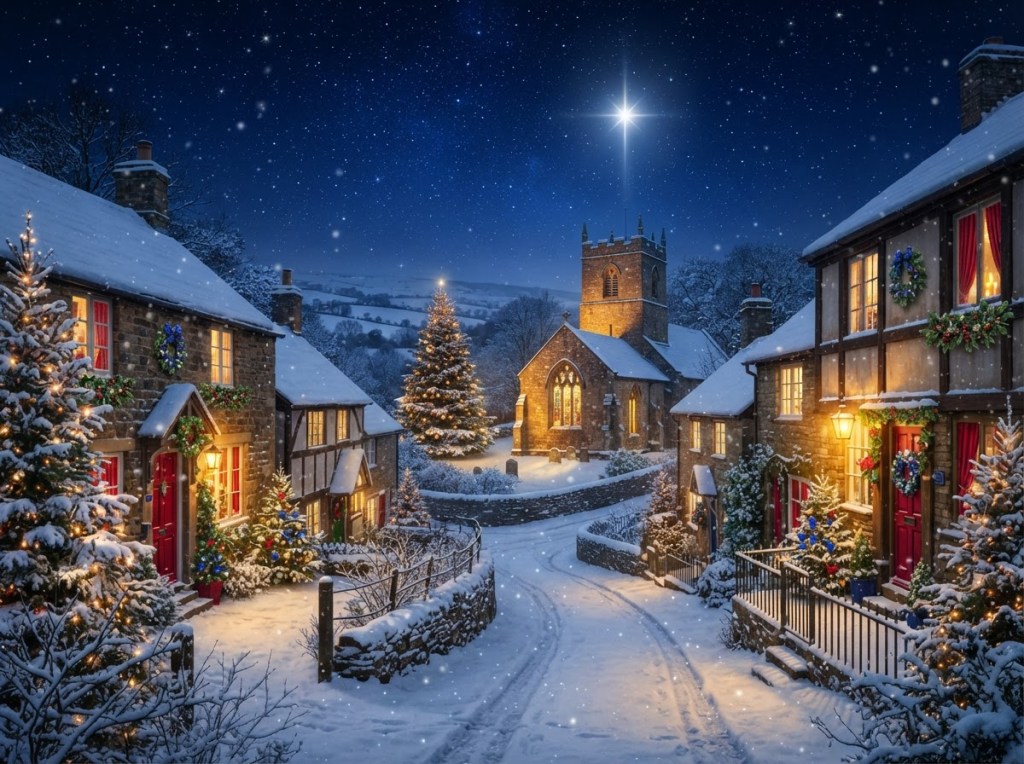
In the bleak mid-winter
Frosty wind made moan
Earth stood hard as iron
Water like a stone
Snow had fallen, snow on snow
Snow on snow on snow
In the bleak mid-winter
Long ago
Heaven cannot hold Him
Nor earth sustain
Heaven and earth shall flee away
When He comes to reign
In the bleak mid-winter
A stable-place sufficed
The Lord God Almighty
Jesus Christ
What can I give Him
Poor as I am?
If I were a shepherd
I would bring a lamb
If I were a wise man
I would do my part
Yet what I can I give Him
Give my heart
In the bleak mid-winter
Frosty wind made moan
Earth stood hard as iron
Water like a stone
Snow had fallen, snow on snow
Snow on snow on snow
In the bleak mid-winter
Long ago
In the Bleak Midwinter
Words by Christina Rossetti, 1872; music by Gustav Holst, 1906
Few carols paint a winter scene as clearly as this one, with its moaning wind, ground hard as iron, and snow falling on snow. The words came from Christina Rossetti, one of the most admired English poets of the Victorian era. She called her poem simply “A Christmas Carol,” and she wrote it to be read, not sung.
The poem had a bumpy road into print. Rossetti first sent it to Macmillan’s Magazine in London in 1868, and the editor turned it down. It found a home across the Atlantic instead, in the January 1872 issue of the American magazine Scribner’s Monthly, next to a nativity illustration. Here’s the curious part. Years later, Rossetti didn’t seem to know how her poem had ended up in Scribner’s. In a letter, she remembered only a small British publication, The People’s Magazine, which printed it in 1873.
For more than thirty years the poem lived quietly in magazines and anthologies. Then the composer Ralph Vaughan Williams began gathering music for a new hymnbook, The English Hymnal, and asked his friend Gustav Holst to write some tunes for it. Holst gave Rossetti’s poem a gentle, simple melody that a whole congregation could sing, and it appeared in the hymnal in 1906. He named the tune “Cranham,” after a small village in the Gloucestershire countryside where his grandparents had lived. Holst lived in a cottage there for a while, and the house was later renamed Midwinter Cottage in honor of the carol. A few years later he wrote his famous orchestral suite, The Planets.
In 1909, Harold Darke, a young student at London’s Royal College of Music, wrote a second setting of the same poem. His version is fuller and more elaborate, and it’s meant for a trained choir. In 2008, BBC Music Magazine asked 51 choirmasters and choral experts in Britain and the United States to name the greatest Christmas carol of all time. Darke’s “In the Bleak Midwinter” came out on top.
Rossetti wrote five verses. Many groups, ours included, sing a shorter version and end by repeating the first verse. The last verse she wrote is the one people remember most. The singer has no lamb to bring like a shepherd and no gift to offer like a wise man, so they give the one thing anyone can give, their heart. As a hymn, it never appeared on the pop charts, and both Rossetti’s words and Holst’s tune are now in the public domain.


Leave a Reply