
Lyrics in the public domain
The First Noel the angel did say
Was to certain poor shepherds in fields as they lay
In fields as they lay, keeping their sheep,
On a cold winter’s night that was so deep
Noel, Noel, Noel, Noel,
Born is the King of Israel
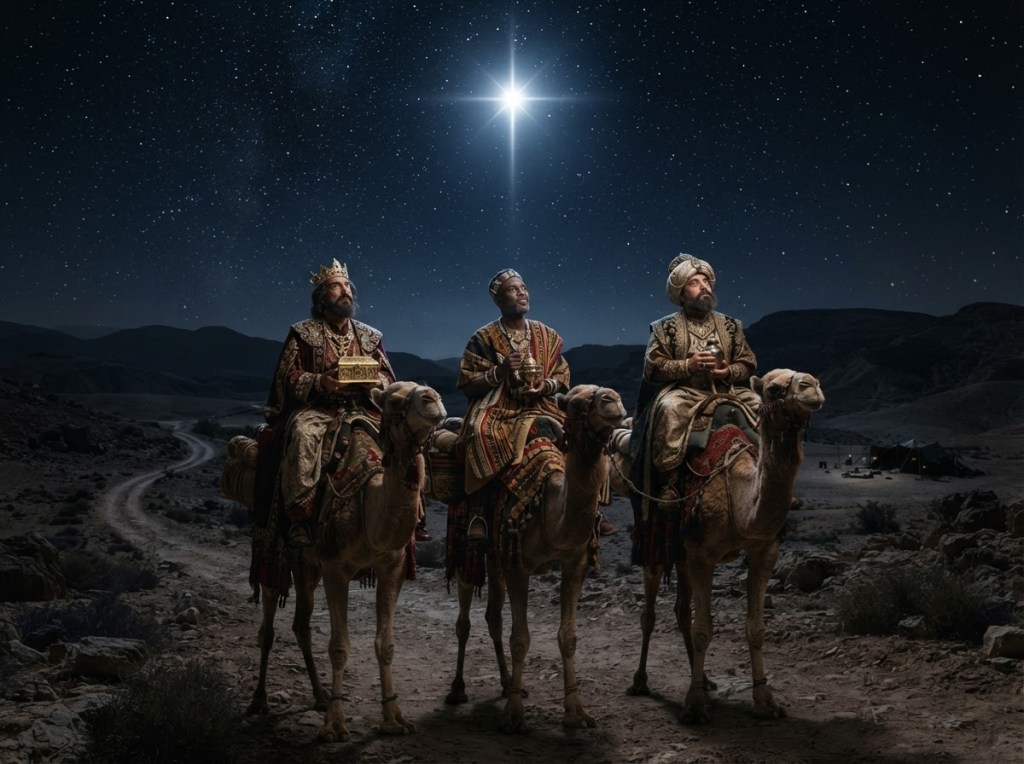
They looked up and saw a star
Shining in the east beyond them farr
And to the earth it gave great light
And so it continued both day and night
Noel, Noel, Noel, Noel,
Born is the King of Israel
And by the light of that same star
Three wise men came from country far
To seek for a king was their intent
And to follow the star wherever it went
Noel, Noel, Noel, Noel,
Born is the King of Israel
Then let us all with one accord
Sing praises to our heavenly Lord
That hath made Heaven and earth of nought
And with his blood mankind has bought
The First Noel
Traditional, arranged by John Stainer, 1871
No one knows who wrote “The First Noel.” It’s an anonymous English folk carol, probably from the 1600s, and it was passed along by ear in Cornwall, England’s far southwestern corner. People sang it for generations before anyone thought to write it down. The odd-looking word in the title is an old English spelling of Noël, the French word for Christmas, and both go back to the Latin natalis, meaning “birth.”
The carol was nearly lost, and we owe its survival to a rather unexpected man. Around 1816, a Cornishman named John Hutchens wrote out the words by hand for Davies Gilbert, a Member of Parliament who would later become President of the Royal Society, Britain’s most distinguished scientific body. Gilbert loved the old carols of his home county and printed the text in the second edition of his collection Some Ancient Christmas Carols in 1823, though without the music. Fittingly enough, this champion of Christmas carols died on Christmas Eve in 1839.
The melody finally appeared in print in 1833, when the London lawyer and antiquarian William Sandys published it in his book Christmas Carols Ancient and Modern. The version most of us sing today came in 1871, when the organist John Stainer and the clergyman Henry Ramsden Bramley, colleagues at Magdalen College, Oxford, gave it the warm four-part harmony that fills churches and community halls every December.
If the tune feels easy to pick up, there’s a reason. The same musical phrase repeats almost unchanged, first in the opening lines and again in the chorus. Some music scholars have grumbled about all that repetition, and one well-known British hymn expert teasingly called it “a terrible tune.” But that simplicity is just what makes it so beloved for singing together. You’ll know it by the second verse.
The carol tells the Nativity story in a gentle, unhurried way, from the shepherds in the fields to the wise men following the star. Folk songs like this one were never on the charts, of course, but “The First Noel” has never gone out of style. In recent years, recordings by artists from Whitney Houston to Gabby Barrett have appeared on Billboard’s holiday and gospel charts, more than two centuries after it was first written down.


Leave a Reply