
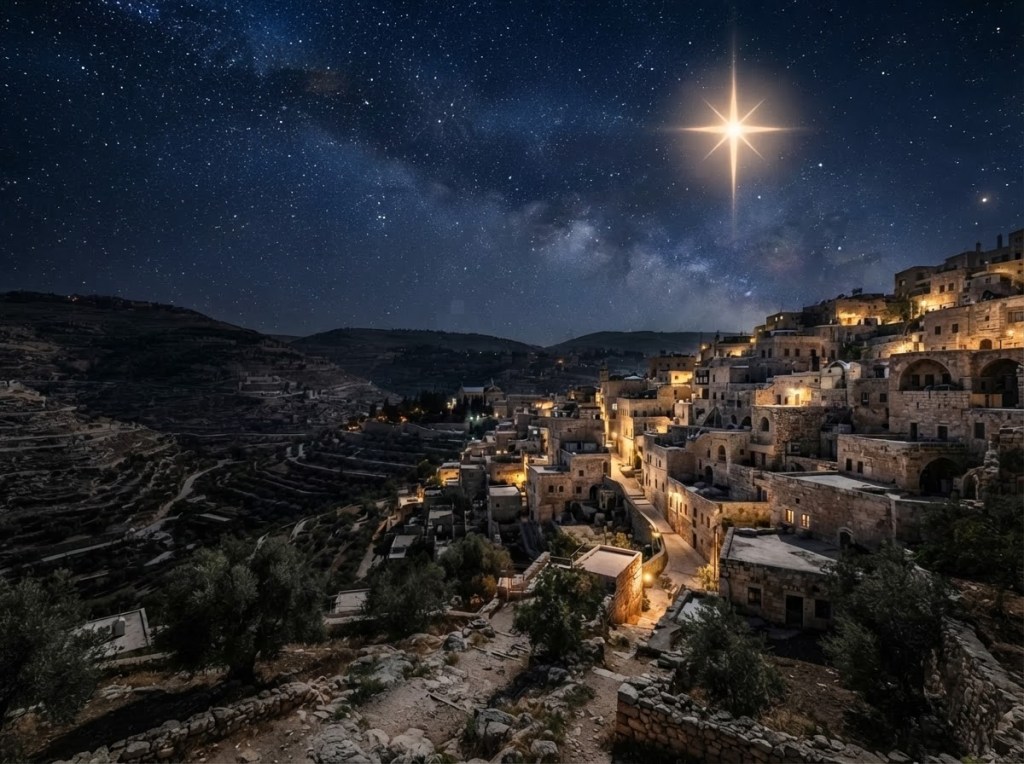
Public domain lyrics.
O little town of Bethlehem
How still we see thee lie
Above thy deep and dreamless sleep
The silent stars go by
Yet in thy dark streets shineth
The everlasting Light
The hopes and fears of all the years
Are met in thee tonight
For Christ is born of Mary
And gathered all above
While mortals sleep, the angels keep
Their watch of wondering love
O morning stars, together
Proclaim the holy birth
And praises sing to God the King
And peace to men on earth
How silently, how silently
The wondrous gift is given
So God imparts to human hearts
The blessings of His heaven
No ear may hear His coming
But in this world of sin
Where meek souls will receive Him still
The dear Christ enters in
O holy Child of Bethlehem
Descend to us, we pray
Cast out our sin, and enter in
Be born in us today
We hear the Christmas angels
The great glad tidings tell
O come to us, abide with us
Our Lord Emmanuel
O Little Town of Bethlehem
Words by Phillips Brooks, 1868; music by Lewis Redner, 1868
In 1865, a young Philadelphia minister named Phillips Brooks took a long trip abroad, which included a visit to the Holy Land. On Christmas Eve he rode on horseback from Jerusalem out to Bethlehem. He crossed the fields where, by tradition, the shepherds first heard the news. Then he attended a Christmas Eve service at the Church of the Nativity that lasted from late at night into the early hours of Christmas morning. He never forgot it.
Three years went by before that memory turned into a song. In December 1868, Brooks was rector of the Church of the Holy Trinity in Philadelphia, and he wanted a new carol for the children to sing at their Sunday school Christmas service. He wrote five short verses. He gave them to his friend Lewis Redner, the church organist, and asked him for a simple tune the children could sing.
Redner wasn’t a professional musician. He sold real estate for a living. He was also devoted to that Sunday school, and as its superintendent he’s credited with growing it from a few dozen children to more than a thousand. He kept putting off the tune, though, and he later admitted it was written “in great haste and under great pressure.” On the Friday before the service, Brooks asked whether he had “ground out that music yet.” Redner said no, but promised it by Sunday. On Saturday night he went to bed with nothing. Late in the night he woke suddenly with a melody in his head, which he said felt like an angel whispering in his ear. He jotted it down, filled in the harmony the next morning, and hurried off to church. The children sang it for the first time on December 27, 1868.
Neither man expected the carol to outlast that one Christmas. A local bookseller printed it on leaflets, and other churches picked it up. In 1874 the words and music were published together for the first time, in a collection edited by William Huntington, who gave Redner’s tune the name “St. Louis.” Some think the name was a gentle play on “Lewis.”
Most of us sing only four of Brooks’s five verses. Some readers objected to a line in his original fourth verse, so Brooks rewrote it and later dropped that verse altogether, and singers have left it out ever since. On the other side of the Atlantic, the same words have their own tune. In Britain and Ireland they’re sung to “Forest Green,” an old English country melody that the composer Ralph Vaughan Williams heard from a singer in a Surrey village and set to the carol in 1906.
Like most hymns, “O Little Town of Bethlehem” never appeared on any chart. It’s simply been sung, year after year, in churches, schools, and living rooms. Phillips Brooks became one of the best-known preachers in America and later served as Episcopal Bishop of Massachusetts. Still, these few gentle verses written for a children’s Christmas service are what most people remember him for. The words and music are in the public domain, free for everyone to sing.


Leave a Reply