
These words are in the public domain.
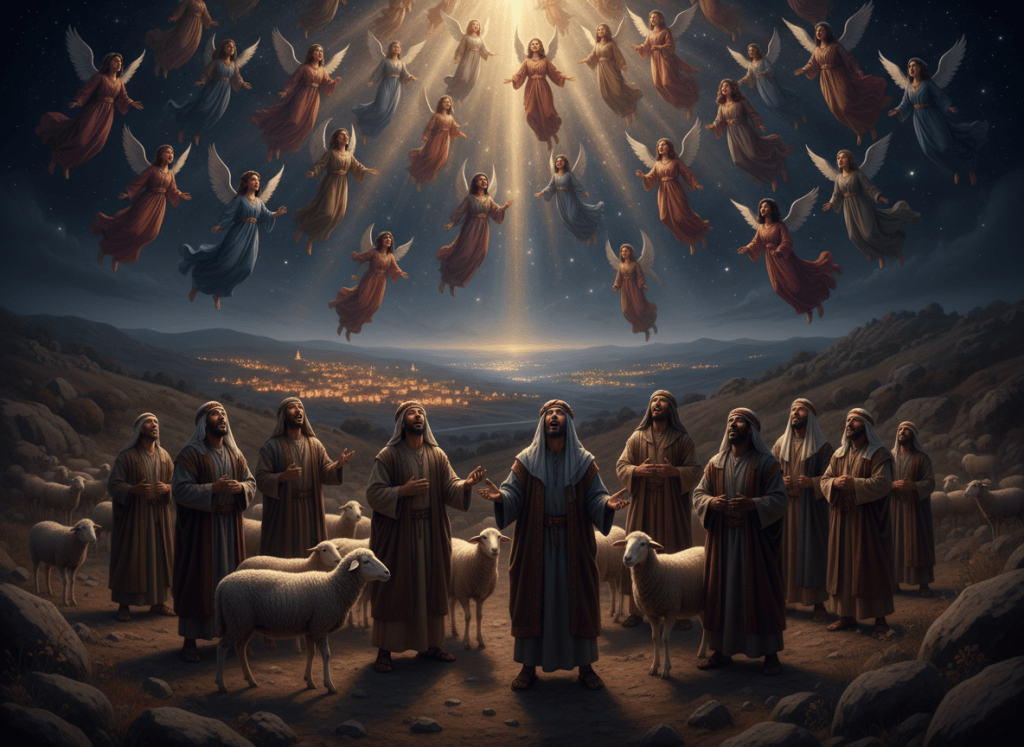
Angels we have heard on high,
Sweetly singing o’er the plains,
And the mountains in reply
Echoing their joyous strains.
Gloria… in excelsis Deo!
Gloria… in excelsis Deo!
Shepherds, why this jubilee?
Why your joyous strains prolong?
What the gladsome tidings be
Which inspire your heavenly song?
Gloria… in excelsis Deo!
Gloria… in excelsis Deo!
Come to Bethlehem and see
Christ whose birth the angels sing;
Come, adore on bended knee
Christ the Lord, the newborn King.
Gloria… in excelsis Deo!
Gloria… in excelsis Deo!
See Him in a manger laid,
Whom the choirs of angels praise;
Mary, Joseph, lend your aid,
While our hearts in love we raise.
Gloria… in excelsis Deo!
Gloria… in excelsis Deo!
Angels We Have Heard On High
Traditional French carol; English words by James Chadwick, 1860; music arranged by Edward Shippen Barnes, 1937.
This beloved carol began in the south of France. Its earliest known printing came in 1805, in a collection of French and Provençal Christmas songs published in Marseille by a Franciscan friar known as Père Roche. That early version opened with different words, ran to twelve verses, and already carried the Latin refrain that everyone waits for, “Gloria in excelsis Deo,” meaning “Glory to God in the highest.” Those are the words the angels sing to the shepherds near Bethlehem in the Christmas story told in the Gospel of Luke. No one knows for certain who wrote the carol. Roche was the first to publish it, but scholars are careful not to name him as its author.
The tune we sing today didn’t turn up in print until 1842, in a Paris hymn collection where the carol was labeled a Christmas song from Languedoc, the region along France’s Mediterranean coast. By then its opening line had become “Les anges dans nos campagnes,” or “the angels in our countryside.”
The English words came from James Chadwick, an Irish-born priest who later became a Catholic bishop in the north of England, remembered for his gentle and gracious manner. His version first appeared in 1860, and it is more a fresh English song inspired by the French than a word-for-word translation. Here’s a curious wrinkle: Chadwick’s lines each had one extra syllable at the start, so they didn’t sit naturally on the tune. Two years later, an unknown editor smoothed out the rhythm for a Catholic devotional manual, and that tidied-up text is the ancestor of what we sing now. Other small changes crept in over the years, too. Chadwick’s shepherds once prolonged their “rapturous strain” before the words settled into “joyous strains.”
Then there’s the music. The rich harmony found in so many American hymnals is credited to Edward Shippen Barnes, an American church musician who arranged it in 1937. But Barnes borrowed an arrangement published in 1891 by Charles Hutchins, an Episcopal musician, note for note. His real contribution was stretching Hutchins’s single “Gloria” into the two-part refrain we know so well.
That refrain is the heart of the carol’s charm. The long, rolling “Glo-o-o-ria” gives every voice in the room a chance to soar, which may be why it has lasted so long in churches, schools, and carol sings. In Britain, the same melody is also widely sung with another favorite, “Angels from the Realms of Glory.” This carol was never a record-chart hit. Its popularity comes from more than a century and a half of people simply singing it together, year after year.


Leave a Reply