
O come, all ye faithful, joyful and triumphant,
O come ye, O come ye to Bethlehem;
Come and behold him, born the King of angels;
O come, let us adore him, O come, let us adore him,
O come, let us adore him, Christ the Lord.
God of God, Light of Light,
Lo, he abhors not the Virgin’s womb;
Very God, begotten, not created;
O come, let us adore him, O come, let us adore him,
O come, let us adore him, Christ the Lord.
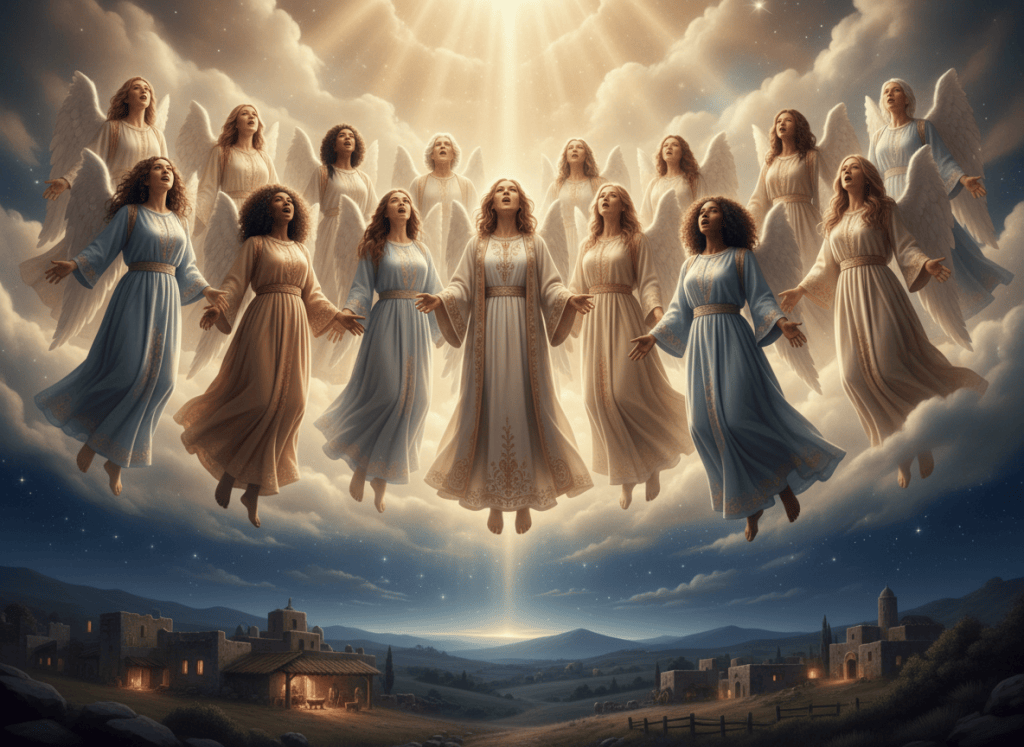
Sing, choirs of angels, sing in exultation,
Sing, all ye citizens of heaven above!
Glory to God, glory in the highest;
O come, let us adore him, O come, let us adore him,
O come, let us adore him, Christ the Lord.
Yea, Lord, we greet thee, born this happy morning;
Jesus, to thee be glory given;
Word of the Father, now in flesh appearing;
O come, let us adore him, O come, let us adore him,
O come, let us adore him, Christ the Lord.
O Come, All Ye Faithful
Written by John Francis Wade, c. 1743; English translation by Frederick Oakeley, 1841
This beloved Christmas carol began life in Latin as “Adeste Fideles,” and for a long time nobody was quite sure who wrote it. Over the years it was credited to all sorts of people, including a king of Portugal. That mix-up came about because Londoners in the late 1700s heard it sung at the chapel of the Portuguese embassy and began calling it “the Portuguese Hymn.” The name stuck long after the trail had gone cold.
The mystery was largely settled in the 1940s, when a Benedictine monk named Dom John Stéphan studied the earliest surviving manuscripts. All of them led back to one man, John Francis Wade. Wade was an English Catholic who lived in the community of English exiles at Douai, in northern France. He earned his living copying music by hand, beautiful plainchant for chapels and private families, and “Adeste Fideles” turned up again and again in his copies. Most scholars now credit him with both the words and the melody.
Here is where the story gets intriguing. Wade lived at a time when many English Catholics in exile hoped to see Bonnie Prince Charlie restored to the British throne, and his manuscripts are sometimes decorated with symbols tied to that cause. Some music historians have suggested the hymn had a hidden second meaning. In their view, the Latin line about the King of Angels, “Regem Angelorum,” echoes “Regem Anglorum,” meaning King of the English, so a carol about Bethlehem may have doubled as a quiet rallying song for the prince. It remains a theory, but it is a lovely bit of intrigue tucked inside such a gentle tune.
The English words most of us sing came about a century later. In 1841, Frederick Oakeley, a priest serving a London congregation, translated the hymn so his people could sing it in their own language. His version, beginning “O come, all ye faithful, joyful and triumphant,” was published in 1852 and spread from there into hymnals across the English-speaking world.
A carol this old was never meant for the record charts, and it has never needed them. Its popularity is measured in centuries of candlelight services, school pageants, and family gatherings. Its sweeping, welcoming opening still invites everyone in the room to come and join the song.


Leave a Reply