
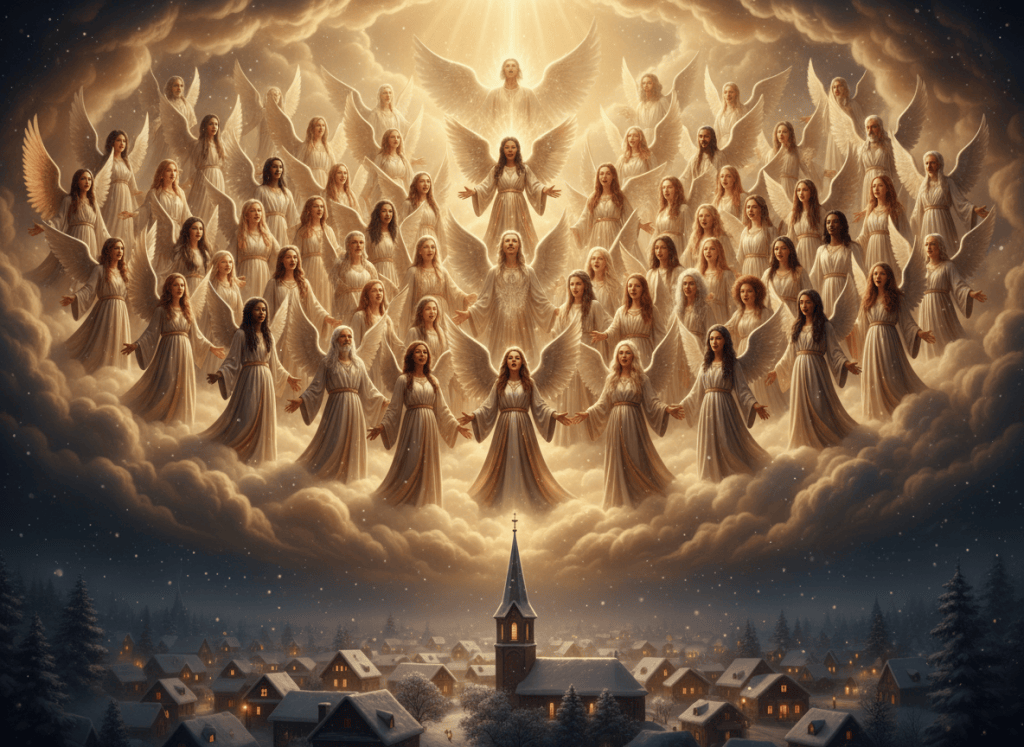
Hark! the herald angels sing,
“Glory to the newborn King;
Peace on earth, and mercy mild,
God and sinners reconciled!”
Joyful, all ye nations, rise,
Join the triumph of the skies;
With th’angelic host proclaim,
“Christ is born in Bethlehem!”
Hark! the herald angels sing,
“Glory to the newborn King!”
Christ, by highest heav’n adored;
Christ, the everlasting Lord;
Late in time behold Him come,
Offspring of a virgin’s womb.
Veiled in flesh the Godhead see;
Hail th’incarnate Deity,
Pleased as man with man to dwell,
Jesus, our Emmanuel.
Hark! the herald angels sing,
“Glory to the newborn King!”
Hail the heav’n-born Prince of Peace!
Hail the Sun of Righteousness!
Light and life to all He brings,
Ris’n with healing in His wings.
Mild He lays His glory by,
Born that man no more may die,
Born to raise the sons of earth,
Born to give them second birth.
Hark! the herald angels sing,
“Glory to the newborn King!”
Hark the Herald Angels Sing
Words by Charles Wesley, 1739; music by Felix Mendelssohn, 1840
This carol comes to us through the hands of several people, none of whom set out to create the carol we know today. The words began with Charles Wesley, the English clergyman and poet who, with his brother John, helped found the Methodist movement. Charles wrote more than six thousand hymns in his lifetime. In 1739 he published a “Hymn for Christmas-Day” in a collection he and John put together. It was a slow, solemn piece of ten short verses, and it began with a line that might puzzle us today: “Hark, how all the welkin rings.” “Welkin” is an old word for the sky or the heavens.
In 1753 the preacher George Whitefield, a friend and fellow traveler of the Wesleys, included the hymn in his own collection. Along the way he changed that opening to the words we sing now, “Hark! the herald angels sing.” The Wesleys were particular about their work. John Wesley later wrote in the preface to one of their hymnbooks that he wished people would stop trying to “mend” their hymns, because they really weren’t able to. Others kept trimming and rearranging the verses anyway over the following decades, until the text settled into something close to our familiar version.
The music has an even more unexpected history. In 1840 the German composer Felix Mendelssohn wrote a festive cantata for men’s chorus and brass. It was part of a celebration in Leipzig marking four hundred years since Johannes Gutenberg’s printing press. One of its rousing choruses honored Gutenberg himself. Mendelssohn was pleased with the tune but felt strongly about where it belonged. He wrote to his English publisher that singers and listeners would like it very much, but that it would never do for sacred words.
Mendelssohn died in 1847, so he never learned how wrong that prediction would turn out to be. In 1855 William Hayman Cummings, a young English organist and singer, noticed that Wesley’s words fit Mendelssohn’s melody. He paired the two for a performance at Waltham Abbey near London. The combination caught on quickly. Within a few years it was appearing in hymnals across England, and it has been a centerpiece of Christmas services, carol concerts, and caroling around the world ever since.
As a hymn from long before recorded music, it never appeared on any popular music charts. Its staying power shows in another way. It has been recorded by countless choirs and singers and is sung by large and small gatherings every December. Today it’s hard to picture a Christmas season without it.


Leave a Reply