
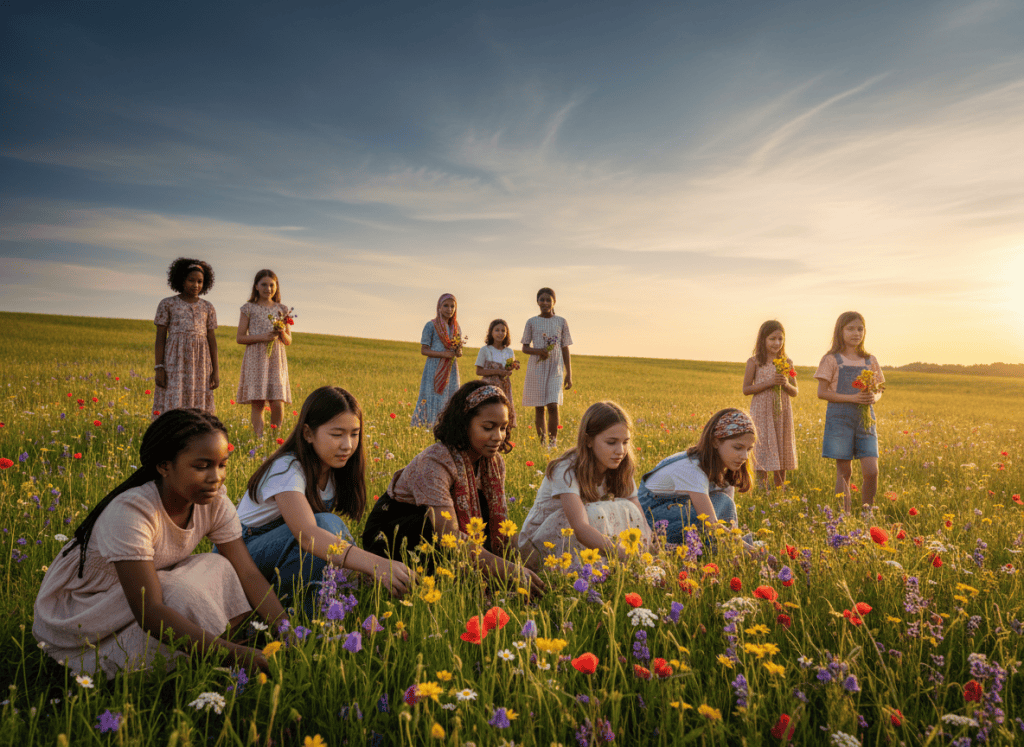
Written by Pete Seeger (1955), with additional verses by Joe Hickerson (1960)
🎵 Sing along with the full lyrics at LyricFind
Pete Seeger wrote this song at 30,000 feet. In October 1955 he was flying to a concert at Oberlin College — one of the few places that would still book him, since the McCarthy-era blacklist had shut him out of radio, television, and most concert halls. Half-dozing, he leafed through his notebook and found three lines he’d copied down a year or two earlier while reading Mikhail Sholokhov’s Russian novel And Quiet Flows the Don: a snatch of Cossack song about flowers picked by girls, girls taken by husbands, husbands taken by the army. He added the weary refrain “when will they ever learn?”, and by the time the plane landed he had three verses. Five years later, Joe Hickerson — a graduate student running the folk club at that very same college — added two more verses that looped the graveyards back to flowers, turning it into an endless circle. Hickerson has drawn royalties ever since, and has joked that he made a good living off of two verses.
There’s a wonderful footnote about how it spread: the Kingston Trio recorded it in 1961 assuming it was an old traditional song with no author. Seeger’s publisher had to get in touch to explain otherwise — and the Trio, to their credit, promptly handed the credit over.
Peter, Paul and Mary had it from the beginning. It appeared on their 1962 self-titled debut — the album that stayed in Billboard’s Top Ten for ten months and announced the folk revival to mainstream America — and it became one of their signature songs for the rest of their fifty-year career. Where Seeger sang it as a lone voice with a banjo, the trio wrapped it in three-part harmony that made it feel like something a whole room could sing, which is exactly what happened: it went with them to rallies, marches, and Vietnam-era protests, and became one of the defining peace anthems of the 1960s. Marlene Dietrich took it around the world in German, French and English, and in 2010 the New Statesman named it one of the twenty greatest political songs ever written. Not bad for three lines borrowed from a Russian novel by a blacklisted banjo player on an airplane.


Leave a Reply