
🎵 Sing along with the full lyrics at LyricFind
(After singing, remember to hit the “back” button to return to Campfire Reunions!)
Hangman
Traditional, arranged by Peter Yarrow, Joel Hendler, Paul Stookey, Mary Travers, and Milton Okun, 1965.
Nobody knows who first sang this one. It’s one of the oldest stories in the folk tradition, and it has traveled a long way to reach us.
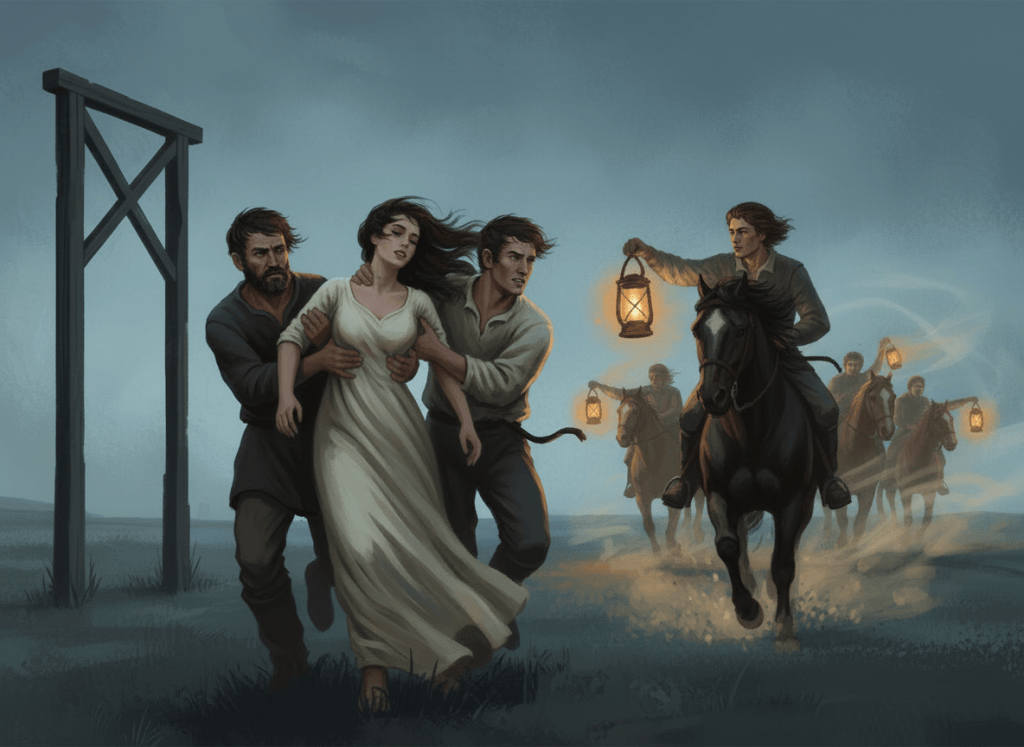
The story is simple. A young woman stands at the gallows and begs the hangman to wait a little while. She sees someone coming. One by one her family arrives, and she asks each of them whether they’ve brought silver or gold to buy her freedom. Each one has come empty-handed, and some have come only to watch. The last to arrive is her true love. Whether the ransom is paid, and whether she goes free, depends on who’s singing it. In the version by Peter, Paul and Mary, the maiden is rescued by her true love.
What’s curious is that the English-language versions never say what she did wrong. The Harvard scholar Francis James Child, who collected the old ballads of England and Scotland in the late 1800s and numbered this one Child Ballad No. 95, called the English versions “defective and distorted.” He felt they had lost the beginning of the story and kept only the ransom scene. Versions elsewhere in Europe fill in the gap: in many of them she has been captured by pirates. In an old English fairy tale called “The Golden Ball,” she is to be hanged for losing a golden ball, and her sweetheart has to go on a spooky adventure to get it back. Some scholars think the “gold” was never really about money. They suggest it stood for her good name.
The song turns up almost everywhere: English villages, the Appalachian mountains, Sweden, Germany, Hungary, Lithuania, and Finland, where about fifty versions have been collected. Americans may know it from Lead Belly, who recorded it as “The Gallis Pole” in 1939, or from Odetta. It even reached rock audiences in 1970, when Led Zeppelin recorded “Gallows Pole.”
Peter, Paul and Mary’s version was never released as a single, so it didn’t chart. The album it came from, See What Tomorrow Brings, reached No. 11 on the Billboard album chart and went gold.


Leave a Reply