
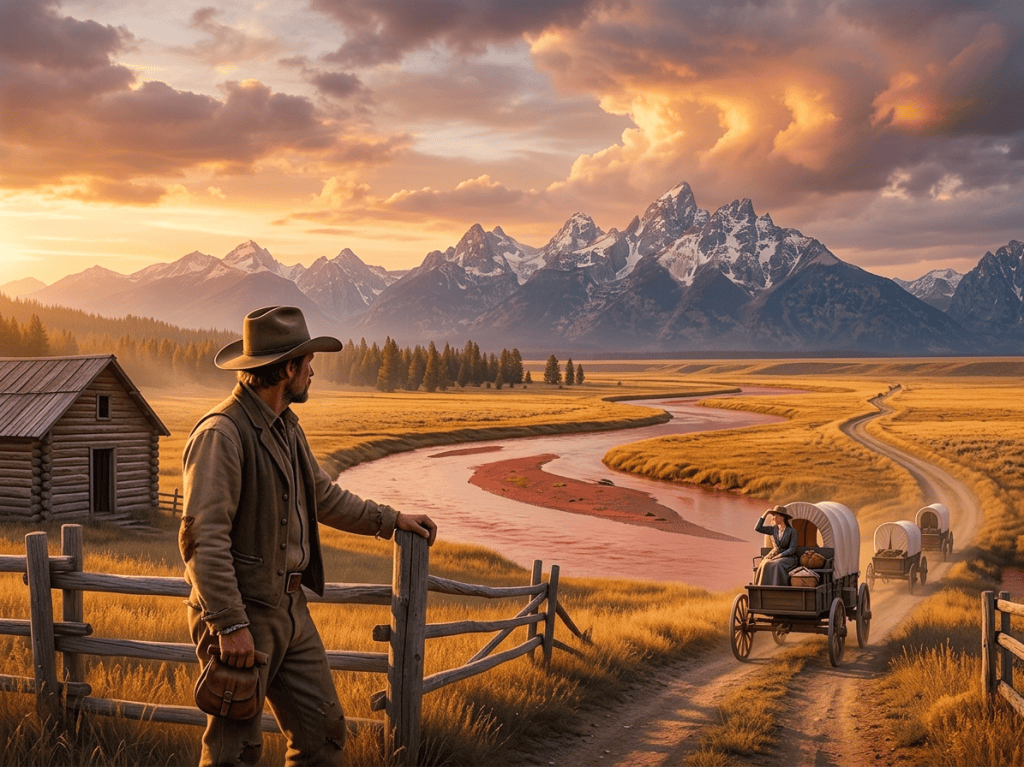
These traditional lyrics are in the public domain, lightly adapted for singalongs.
From this valley they say you are going,
We will miss your bright eyes and sweet smile,
For they say you are taking the sunshine
That brightens our pathway awhile.
Come and sit by my side if you love me,
Do not hasten to bid me adieu,
But remember the Red River Valley
And the one who has loved you so true.
For a long time I have been waiting
For those dear words you never would say,
But at last all my fond hopes have vanished,
For they say you are going away.
Won’t you think of the valley you’re leaving?
Oh how lonely, how sad it will be.
Oh think of the fond heart you’re breaking,
And the grief you are causing to me.
Come and sit by my side if you love me,
Do not hasten to bid me adieu,
But remember the Red River Valley
And the one who has loved you so true.
As you go to your home by the ocean,
May you never forget those sweet hours
That we spent in the Red River Valley
And the love we exchanged ‘mid the flowers.
Come and sit by my side if you love me,
Do not hasten to bid me adieu,
But remember the Red River Valley
And the one who has loved you so true.
Red River Valley
Traditional, first published by James J. Kerrigan, 1896
Few songs feel as much like home around a campfire as “Red River Valley.” Even so, nobody knows for certain who wrote it, or even which Red River it is singing about. Over the years it has traveled under a whole string of names, among them “Cowboy Love Song,” “Bright Sherman Valley,” and “In the Bright Mohawk Valley,” depending on where folks happened to be singing it.
The earliest firmly dated version appeared in 1896. That year, sheet music titled “In the Bright Mohawk Valley” was printed in New York, with a man named James J. Kerrigan listed as the writer. But the song seems to be older than his sheet music. The earliest known handwritten copy of the words carries the notes “Nemaha 1879” and “Harlan 1885,” which may point to places in Nebraska or Iowa.
Then the story turns north. Canadian folklorist Edith Fowke gathered evidence that the song was known in at least five Canadian provinces before 1896. She suspected it was born around 1870, when soldiers of the Wolseley Expedition went to Manitoba’s Red River Valley. In her telling, it began as the lament of a young Métis woman whose soldier sweetheart was leaving with the rest of his company. Part of her case rested on a single word, “adieu,” hardly the farewell you’d expect from a cowboy on the southwestern plains. Many years later, folk song scholar John Garst confirmed much of her work, showing that both the tune and the words were around before Kerrigan’s version. Still, the question has never been fully settled, and many people picture the Red River of Texas when they sing it.
That cowboy reputation grew through early records and movies. Texas singing cowboy Carl T. Sprague recorded it as “Cowboy Love Song” in 1925. In 1927, Hugh Cross and Riley Puckett made the first commercial recording under the title “Red River Valley,” and Carl Sandburg included it in his American Songbag that same year. It was another Texan, Jules Verne Allen, whose 1929 recording made the song most popular, though curiously, Allen himself believed it came from Pennsylvania. In 1936, Gene Autry sang it in a film named for the song, and it has been a Western standard ever since. Woody Guthrie even borrowed the melody for “Jarama Valley,” a song about the Spanish Civil War.
The recording on this page comes from Suzy Bogguss. She sings a few words differently from the traditional lyrics printed above, as folk singers have always done. In 2008, while singing on stage with Garrison Keillor, she noticed that everyone joined in on “Red River Valley” except the children, who didn’t seem to know it. That moment led to her 2011 album American Folk Songbook, along with a songbook she modeled on the one she had used in fifth grade, so a new generation could learn these old favorites and sing along too.


Leave a Reply